Skip to content

Living without a womb, discovering that you are unable to carry a child due to an absent womb can be an emotional journey for British women and couples. Within clinical medicine, this condition is formally identified as absolute uterine factor infertility. Whilst the physical absence of a uterus prevents natural pregnancy, modern assisted conception techniques mean that women can still become biological mothers through carefully managed surrogacy arrangements.
Clinical Reasons Behind Uterine Absence
The medical factors leading to the absence of a womb are categorised by gynaecologists into congenital disorders and acquired surgical conditions:
Congenital Uterine Agenesis (MRKH Syndrome)
Mayer-Rokitansky-Küster-Hauser (MRKH) syndrome is the primary congenital cause of an absent womb in the UK, diagnosed in approximately 1 in 4,500 female births. It occurs when the Müllerian structures fail to develop in the early stages of fetal growth, resulting in the absence of the uterus and upper vagina. However, the ovaries develop normally, producing healthy eggs and female hormones.
Surgical Removal of the Womb (Hysterectomy)
In other cases, a woman may have her womb surgically removed later in life due to pressing medical indications, such as:
- Gynaecological Cancers: Treatment for early-stage cervical, endometrial, or ovarian malignancies.
- Emergency Obstetric Surgeries: Uncontrollable peripartum haemorrhage or severe placenta accreta during a previous delivery.
- Benign Uterine Disease: Severe, disabling adenomyosis or multiple large fibroids altering the pelvic anatomy.
Retaining Genetic Lineage Through IVF Treatment
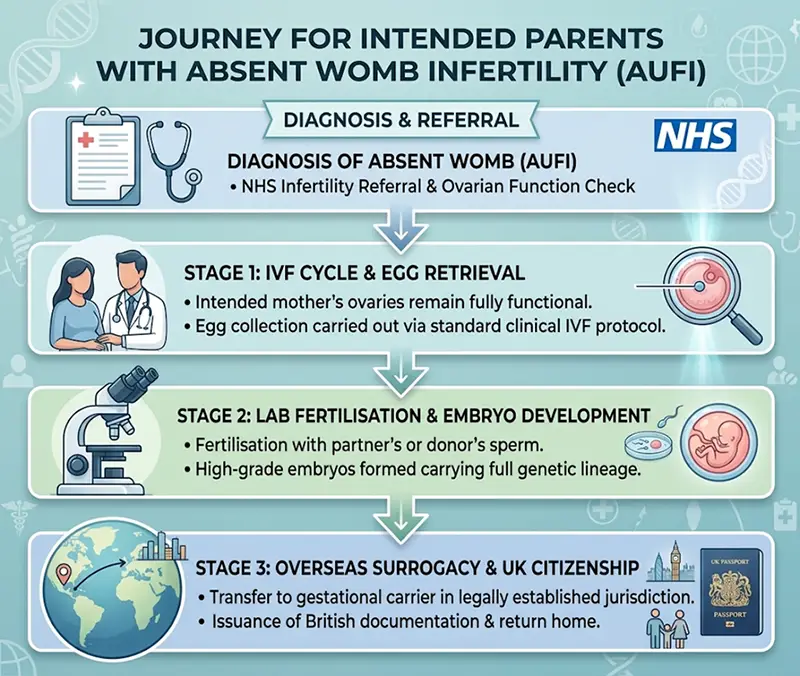
It is vital to understand that an absent womb does not compromise egg quality. Female patients routinely undergo an IVF cycle to collect their own eggs. Once fertilised with the partner’s or donor’s sperm in the laboratory, the resulting embryo carries the intended parents’ full genetic inheritance.
Why UK Intended Parents Choose International Surrogacy
Whilst surrogacy is permitted in the UK, legal complexities surrounding parental orders and altruistic restrictions lead many British couples to seek established overseas programmes where legal parentage can be secured clearly from birth. For heterosexual couples navigating uterine infertility, opting for specialized surrogacy for heterosexual couples provides complete clinical management alongside legally sound arrangements overseas.
Budgeting for an international surrogacy pathway requires clear financial foresight. Intended parents are advised to examine detailed breakdowns regarding surrogacy prices and packages to understand all medical, legal, and travel commitments. Should you wish to discuss your medical history or enquire about tailored options for British citizens, please contact us via the Gestlife agency contact page.
Sources and Resources (Bibliography)
- NHS England: Health A-Z guide on Rokitansky syndrome and hysterectomy clinical recovery. Available at: nhs.uk
- Human Fertilisation and Embryology Authority (HFEA): Code of Practice and Surrogacy Guidance for UK Intended Parents. Available at: hfea.gov.uk
- British Fertility Society (BFS): Clinical guidelines on uterine factor infertility management.