

Your baby has arrived, and the next question lands fast: how do we get the paperwork done? For American families, the answer depends on two facts: where the baby was born and who is recognized as the legal parent at birth. This guide walks you through the birth certificate, the passport and the in-between steps, in plain English. It is general information, not legal advice, and rules vary by state and over time.
Where was your baby born? The question that shapes everything
There are two main scenarios. First, your baby is born in the United States. In the second, a U.S. citizen parent has a baby through surrogacy in another country. The U.S. rules are different in each case, so start by identifying yours.
If your baby is born in the U.S., the baby is generally a U.S. citizen by birth, because of the Fourteenth Amendment and the federal statute on citizenship at birth, 8 U.S.C. § 1401. That is true even when the intended parents are foreign nationals, which matters for the passport steps below.
How do I get the birth certificate? (Born in the U.S.)
Birth certificates are issued by the state or local vital records office where the baby was born, not by the federal government. The hospital collects the information on a birth worksheet and files it with the state. The CDC’s National Center for Health Statistics maintains a directory, Where to Write for Vital Records, that points you to the right office in each state.
Be ready to order several certified copies. You will need them for the passport application, health insurance, the Social Security card and, if you travel, for an apostille.
Can both intended parents appear on the birth certificate?
In many states, yes, but how it happens varies. In states with strong surrogacy laws, a court issues a pre-birth order that identifies the intended parents as the legal parents, and the hospital then prepares the birth certificate accordingly. In other places, a post-birth order or an adoption-type process may be required. Your surrogacy attorney should tell you before the transfer, not after the birth, which path applies in your state.
What is a pre-birth order, and why does it matter?
A pre-birth order is a court order, usually obtained during the pregnancy, that establishes legal parentage in favor of the intended parents once the baby is born. It guides the hospital and the vital records office, and it is often the key document when you apply for a passport or need to prove your relationship to your child. Keep several certified copies, along with the birth certificate.
How do I get my baby’s U.S. passport?
If the baby was born in the U.S., you apply through the Department of State using Form DS-11, in person at an acceptance facility. You will generally need the child’s certified birth certificate, evidence of the parent-child relationship, parental identification, a passport photo and the fee. For children under 16, both parents must appear, or one parent can submit written consent from the other. In surrogacy cases, the court order and the birth certificate listing the intended parents are usually central. Check current requirements on travel.state.gov.
The Social Security number is typically requested at the hospital through the Enumeration at Birth program, and the card arrives by mail a few weeks later.
What if the intended parents are not U.S. citizens?
Your baby is still a U.S. citizen at birth if born on U.S. soil, but you will probably need a second passport from your own country, because that is the nationality you will want to document as a family. Consulates have their own rules. Some countries require a court order, a DNA test or a judicial recognition step before registering the birth. Others have been tightening their rules in recent years, especially for children born through surrogacy abroad. Contact your consulate early, ask for the requirements in writing and speak with a lawyer in your home country.
What if a U.S. citizen parent has a baby through surrogacy abroad?
In that scenario, you generally apply for a Consular Report of Birth Abroad (CRBA) at the U.S. embassy or consulate. The Department of State requires evidence of the child’s relationship to a U.S. citizen parent, and in assisted reproduction cases may ask for DNA evidence and documents showing who the legal parents are under local law. The government has updated how it treats children born through assisted reproductive technology, so verify the current policy on travel.state.gov and in the USCIS Policy Manual before you travel.
Apostille: when your documents travel abroad
If you need your U.S. documents recognized abroad, for example to register your child in another country, you may need an apostille under the Hague Apostille Convention. For state-issued documents such as birth certificates, the apostille is generally issued by the Secretary of State of the issuing state. The Hague Conference explains how the system works and which countries participate.
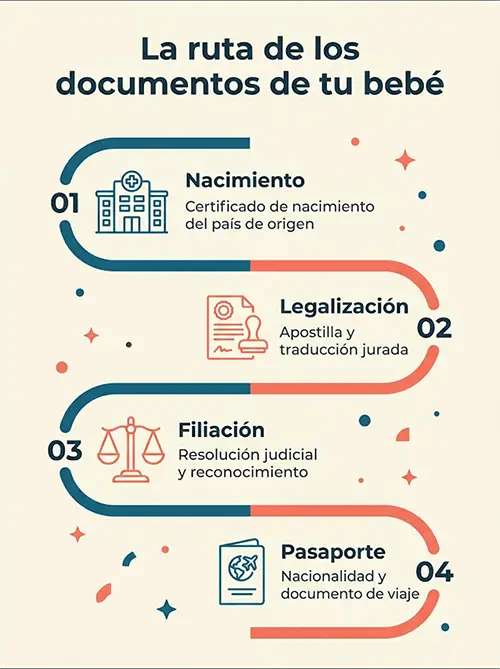
A realistic timeline
- Days 1 to 3: hospital paperwork, birth worksheet, Social Security enumeration.
- Weeks 1 to 4: certified birth certificate copies from the state.
- Weeks 2 to 6: passport application and processing, which varies with demand.
- Weeks to months: consular steps and foreign registration, if applicable.
Timing is not guaranteed. Build in a buffer, especially if you need to travel soon after the birth.
The five mistakes we see most often
- Ordering only one copy of the birth certificate.
- Waiting until after the birth to ask about a parentage order.
- Assuming the consulate of your home country will accept a U.S. document without an apostille or a translation.
- Booking flights before the passport is in hand.
- Skipping professional legal advice to save money.
Heterosexual couples: how the paperwork flows
For heterosexual couples, the pre-birth order commonly names both intended parents, and the paperwork often follows a predictable sequence. If you are comparing options, you can see how our surrogacy programs for heterosexual couples organize the legal and medical phases, including document planning.
Budgeting for paperwork
Certified copies, apostilles, translations, legal fees and extended stays after the birth are part of the real budget. To understand how a full program is typically itemized, review our page on the cost of surrogacy.
Quick answers
- Who issues a baby’s birth certificate?
The state or local vital records office where the baby was born. - Do I need a court order?
In many surrogacy cases, yes. It establishes parentage and is often required for the birth certificate and passport. - Can both parents sign for the passport?
For a child under 16, both parents appear, or one submits notarized consent from the other. - Is the baby automatically a U.S. citizen?
If born in the U.S., generally yes. If born abroad, it depends on the parents’ citizenship and legal relationship to the child.
Paperwork is not the part of the journey anyone dreams about, but it protects your family for the long run. Clarify the legal parentage path early, order multiple certified copies, check the current rules with official sources and bring in qualified counsel. With a plan, the documents become a checklist instead of a source of stress.