

Altruistic surrogacy is an arrangement in which a surrogate carries a child for intended parents without receiving commercial compensation, although permitted expenses may be reimbursed. Avoiding common surrogacy mistakes means looking beyond good intentions to independent advice, informed consent, healthcare and support after birth. Structured programmes, including those offered by Gestlife, can provide a more coordinated alternative to informal arrangements, but their safeguards need careful scrutiny. (hfea.gov.uk)
What are the biggest mistakes in altruistic surrogacy?
The biggest mistakes are assuming that an unpaid arrangement is automatically ethical, treating trust as a substitute for independent advice, overlooking the surrogate’s autonomy and leaving parenthood arrangements until pregnancy is underway. Professional guidance emphasises informed consent, separate legal representation and psychological support because personal goodwill cannot replace these protections. (acog.org)
Importantly, altruistic and structured are not opposites. An altruistic arrangement can involve a licensed clinic, specialist solicitors and counselling. Equally, paying an agency does not establish that every aspect of its service is regulated or independently supervised. The useful comparison is between the safeguards an arrangement actually provides, rather than the label attached to it. (hfea.gov.uk)
Start with a practical test: ask everyone involved to explain what would happen if treatment failed, circumstances changed or expectations differed. Treat an unclear answer as something to resolve before proceeding, not a detail to revisit once emotions and money are committed.
Mistaking generosity for freedom from pressure
A relative or friend offering to help deserves the same opportunities for confidential advice as someone introduced through an organisation. Professional ethical guidance recognises that family relationships can create pressure, even where no commercial payment is involved. A sincere wish to help and difficulty saying no can exist together. (prod.asrm.org)
Consider a sister who volunteers after watching years of fertility treatment. Rather than accepting immediately, suggest private counselling and time away from family discussions. Ask whether she can reconsider without having to justify herself to everyone at the next family gathering. Her willingness should never be treated as a debt owed to the intended parents.
Use separate conversations to explore:
- Personal motivation: what she hopes to contribute, and any worries she has not felt comfortable sharing.
- Family boundaries: how appointments, childcare and recovery might affect her household.
- Communication: who receives updates and what information remains private.
- Disagreement: how concerns will be raised without relatives taking sides.
Keep joint discussions, too, but do not make them the only setting for difficult conversations. Ask the counsellor to help distinguish genuine agreement from a wish to avoid disappointing someone. Record unresolved issues rather than smoothing them over with reassurance.
Overlooking pregnancy’s physical and emotional significance
Pregnancy should not be treated as a purely logistical service. A surrogate needs information about physical, psychological and social risks, alongside support that respects her own experience. Ethical guidance also recognises her authority over her medical care throughout treatment, pregnancy, birth and recovery. (prod.asrm.org)
Use neuroscience carefully, not as a prediction
Research has documented changes in brain structure during pregnancy and after childbirth. A 2024 longitudinal study examined changes across late pregnancy and early postpartum, while another study followed one individual before, during and after pregnancy. These findings underline the significance of pregnancy, but they do not establish how an individual surrogate will feel or prove that separation inevitably causes psychological harm. (nature.com)
The practical response is neither to dismiss attachment nor to assume distress. Ask how the surrogate would like her contribution acknowledged, what support she wants around birth and who she can contact afterwards. Leave room for feelings that do not match anybody’s expectations.
Make aftercare part of the original plan
Before treatment, agree how postnatal support will be arranged and funded. Include access to confidential counselling, medical follow-up and a way to revisit expectations about contact. Professional guidance supports psychological preparation and support rather than relying solely on an initially positive relationship. (acog.org)
For example, discuss whether updates will be exchanged directly or through an agreed intermediary. Avoid promising unlimited contact simply to reassure someone before treatment. Aim for an honest, flexible plan that respects the surrogate’s privacy and keeps the child’s interests central.
What legal mistakes matter in the UK and Spain?
The central legal mistake is assuming that a private agreement, genetic connection or foreign birth certificate automatically establishes parenthood at home. UK and Spanish rules differ substantially, and removing commercial compensation does not remove legal restrictions. Obtain advice before treatment from specialists in every relevant jurisdiction. (gov.uk)
UK arrangements require post-birth legal planning
In the UK, the surrogate is the legal mother at birth, including when she has no genetic connection to the child. Her spouse or civil partner may be the second legal parent, depending on consent and circumstances. Legal parenthood can subsequently be transferred through a parental order or adoption, as appropriate. (gov.uk)
Surrogacy agreements are not enforceable under UK law. They can record intentions and support discussion, but a signed document cannot guarantee the planned outcome. Ask a specialist solicitor to explain eligibility, consent requirements, timing and the evidence needed for your particular route to parenthood. (gov.uk)
For overseas arrangements, seek independent advice both in the UK and in the destination country. British government guidance warns that bringing a child home can be lengthy and complicated. Build nationality, travel documentation and UK parenthood procedures into the plan rather than treating them as administration after delivery. (gov.uk)
Spain does not provide an altruistic exception
It is misleading to describe altruistic surrogacy in Spain as simply unregulated. Article 10 of Law 14/2006 makes surrogacy contracts null and void whether or not payment is involved, and determines maternity by childbirth. An unpaid agreement therefore does not create an exception to that rule. (boe.es)
Spain’s instruction of 28 April 2025, published on 1 May 2025, also changed registration procedures for overseas surrogacy births. It prevents direct registration through the foreign certificates or judgments specified in the instruction, while preserving applicable ordinary routes for establishing parentage. Families with Spanish connections need individual advice about parentage and, where relevant, adoption; an agency cannot override Spanish law. (boe.es)
Confusing altruistic surrogacy with a cost-free arrangement
Altruistic does not mean free of expenses. The HFEA identifies reasonable expenses such as maternity clothing, travel and lost earnings, alongside separate fertility treatment costs. UK guidance also explains that payments exceeding reasonable expenses require family court authorisation before a parental order can be made. (hfea.gov.uk)
Prepare an itemised budget rather than agreeing a vague promise to “cover everything”. Separate treatment, legal advice, counselling, permitted reimbursements and travel. For an overseas arrangement, ask your advisers to identify insurance requirements, exclusions and possible costs during a longer stay.
Agree a practical reimbursement process: which records to retain, who approves payments and how questions will be resolved. Avoid making the surrogate repeatedly negotiate ordinary agreed expenses. Ask your solicitor to review the proposed payment arrangements before money changes hands.
Skipping medical assessment or trying to control care
Knowing someone well is not a substitute for clinical assessment. The HFEA highlights fertility treatment risks and screening for infections before treatment. A clinic should explain the proposed treatment, relevant screening and individual risks rather than simply accepting a privately agreed plan. (hfea.gov.uk)
Ask how the team approaches embryo transfer and complications. ASRM guidance recommends single-embryo transfer in gestational-carrier cycles because multiple pregnancy carries additional obstetric risks. Although this is US professional guidance rather than UK law, it provides a useful question to raise with the treating clinician. (asrm.org)
Discuss prenatal testing, possible complications and differing views about pregnancy management before treatment. These conversations help identify incompatibilities; they do not transfer control over the surrogate’s body to the intended parents. Her informed consent remains central to her medical care. (prod.asrm.org)
How can a structured programme such as Gestlife help?
A structured programme can be preferable to an informal arrangement when it coordinates legal advice, clinical assessment, psychological support and post-birth planning, with clear responsibilities throughout. Gestlife describes a multidisciplinary approach involving legal and medical guidance, while its published safeguards include screening and follow-up for surrogates. These are provider-described services, not independent proof of better outcomes. (gestlifesurrogacy.com)
When reviewing Gestlife surrogacy services, use the consultation to establish who does what. Ask which clinic provides treatment, which lawyers advise each party and who handles concerns outside normal appointments. Coordination is valuable only when responsibility is clear and participants can raise concerns independently.
A useful way to assess any proposed pathway is to request evidence at each stage:
- Before commitment: a written explanation of eligibility, destination law and the route to parenthood at home.
- Before treatment: confirmation of clinical assessment, counselling and genuinely independent legal advice for the surrogate.
- During pregnancy: named contacts, an agreed communication plan and clear escalation arrangements.
- Around birth: a documentation plan, contingency arrangements and support that respects medical consent.
- After birth: defined access to medical and psychological follow-up, alongside completion of legal procedures.
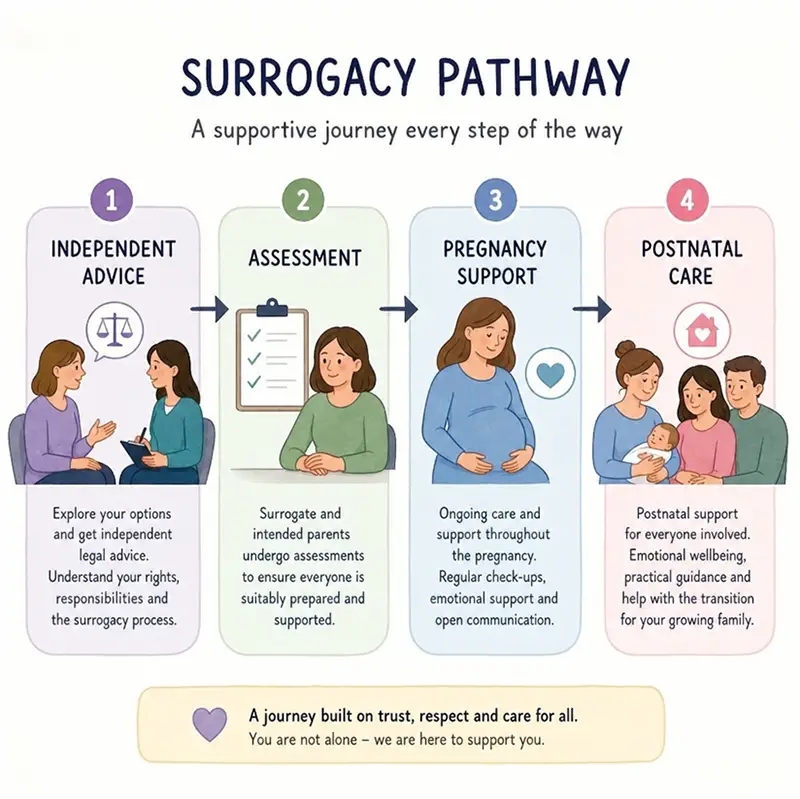
Gestlife’s published programme safeguards describe independent legal counsel for surrogates in specified destinations and medical and psychological follow-up. The page also states that guarantees vary by country and legislation. Request the current contractual terms for your destination, including availability for UK clients, exclusions, complaints procedures and the independence of each adviser.
Treat this as due diligence, not distrust. Ask for plain-English answers where terms are unclear, and take time to review them away from a sales conversation. Do not infer that every service is included because it appears somewhere on a provider’s website.
A practical check before making a commitment
Use this checklist in separate discussions with the surrogate, clinic and legal advisers. Ask for documents or named contacts wherever possible, rather than accepting general reassurance. Keep unresolved points visible until there is an answer everyone understands.
- Voluntary participation: has the surrogate had confidential space to consider the arrangement without family or financial pressure?
- Independent advice: does each party know whom their lawyer represents, and can the surrogate obtain advice privately?
- Medical responsibility: are screening, treatment decisions, emergency care and recovery arrangements clearly allocated?
- Financial clarity: are permitted expenses, additional costs, insurance exclusions and reimbursement procedures documented?
- Legal parenthood: has a specialist explained the route in the birth country and at home, including travel documents?
- Long-term support: is there a workable plan for counselling, postnatal care, contact and preserving information for the child?
Set a personal stopping rule: do not proceed while a fundamental issue remains unanswered. A friendly relationship, attractive package or encouraging consultation should not replace understanding the implications. Independent legal, medical and psychological advice are recognised safeguards across professional surrogacy guidance. (acog.org)
Choose safeguards, not reassuring labels
The most useful way to avoid surrogacy mistakes is to test the arrangement rather than assume that altruism guarantees protection. Trust matters, but it needs practical boundaries and independent advice behind it. A structured programme such as Gestlife may offer valuable coordination; assess its written commitments with the same care you would apply to an informal arrangement. Before committing, ask for a detailed pathway and have your own specialist advisers review it.