

The birth of your child through gestational surrogacy is a moment of profound joy. However, the days immediately following the delivery are dominated by critical legal and administrative tasks. For intended parents—especially international couples returning to Europe, Latin America, or Asia—securing the proper civil registry registration and obtaining an original birth certificate reflecting your legal parentage is the most important step of the entire journey.
In this comprehensive guide, we will explore how the legal framework operates (with a focus on the United States, the global “Gold Standard” for surrogacy law), how court orders dictate the issuance of vital records, and the crucial steps for international parents.
The Foundation: Pre-Birth Orders and Parentage
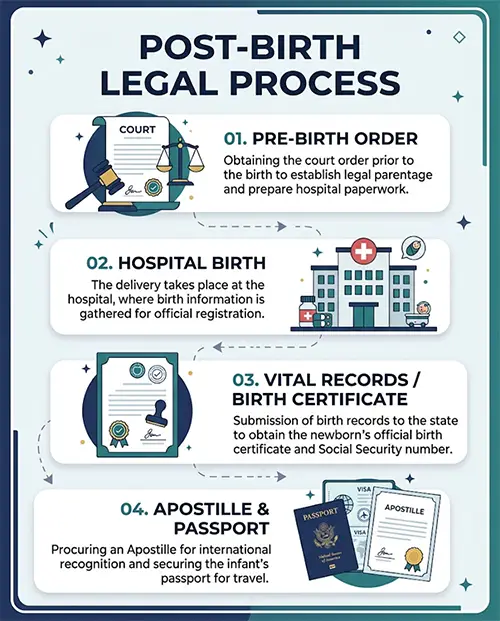
Unlike traditional childbirth, where the woman giving birth is automatically recorded as the mother, gestational surrogacy requires legal intervention to override this biological presumption. In surrogacy-friendly US states (such as California, Nevada, or Illinois), this is achieved through a Declaratory Judgment of Parentage, commonly known as a Pre-Birth Order (PBO).
A PBO is a court order issued by a judge during the second or third trimester of pregnancy. It instructs the hospital and the Department of Vital Records (the equivalent of a civil registry) to place the names of the Intended Parents directly on the original birth certificate, bypassing the surrogate entirely. You can learn more about the strict legal protocols governing these contracts through authoritative bodies like the American Bar Association (ABA) – Family Law Section.
At the Hospital: Executing the Court Order
When the baby is born, the hospital’s birth registrar will review the court order. Based on this document, they will submit the birth data to the state’s vital statistics office. This ensures that the first and only birth certificate issued will list the Intended Parents.
For parents managing the logistics of international travel, understanding the paperwork required during these first few days is vital. We highly recommend reviewing our checklist on the surrogacy birth procedures (birth procedures for a surrogacy child) to ensure you have all hospital clearances, medical powers of attorney, and discharge papers ready.
The International Dimension: Apostilles and Civil Registries Abroad
While US intended parents simply receive their birth certificate and Social Security Number (SSN) in the mail, international parents face a more complex second phase: bringing the child home and registering them in their domestic civil registry.
To ensure a foreign birth certificate is recognized by a European or Latin American civil registry, it must carry an Apostille (a specialized international authentication under the Hague Convention).
Navigating European Consulates
The process of registering the birth at your home country’s consulate varies dramatically depending on your nationality:
- Direct Recognition: Some countries will accept the US birth certificate and court order and directly transcribe it into their national civil registry.
- Biological Recognition Only: Other jurisdictions will only recognize the genetic father initially, requiring the non-biological parent to complete a stepchild adoption upon returning home.
For example, the legal process in Spain, referred to as the [inscripción registro civil bebé subrogado], demands a rigorous legal review of the foreign court judgment (exequatur) to ensure it complies with Spanish public order before granting full transcription. This highlights why intended parents must have specialized legal counsel in both the birth country and their home country.
Securing Your Child’s Legal Identity
Managing the civil registry birth registrations for a child born through surrogacy is an exact science that requires coordination between fertility lawyers, hospital administrators, state vital records offices, and international consulates. Any error in the spelling of names, or a delay in securing an Apostille, can result in expired visas and stranded families. By working with top-tier surrogacy agencies and experienced reproductive attorneys, you guarantee that your child’s legal identity is established securely, allowing you to focus on what truly matters: welcoming your new baby.