Skip to content

The narrative of American family building has fundamentally transformed over the past few decades. In metropolitan centers across the United States, an increasing number of professionals are choosing to prioritize higher education, career establishment, personal development, and financial stability before embarking on the journey of raising children, effectively postponing parenthood to later stages in life. This societal shift reflects a cultural movement toward intentional parenthood—where prospective parents seek to ensure that their home environment, emotional maturity, and financial resources are fully established before bringing a child into the world.
However, while personal and professional readiness often peaks in one’s late thirties and forties, human biology remains tied to evolutionary timelines. Navigating the intersection of career success and age-related reproductive shifts requires a clear understanding of reproductive endocrinology, advanced fertility treatments, and legal frameworks such as gestational surrogacy.
The Socioeconomic Shift: Why Americans Are Postponing Parenthood
Data compiled by the National Center for Health Statistics (NCHS) and the U.S. Census Bureau highlight a dramatic demographic transition: birth rates among American women in their early twenties have dropped significantly, while first-time births among women aged 35 to 44 have reached unprecedented levels as more couples are postponing starting a family. This transition is especially evident in high-cost, career-intensive urban areas such as New York City, San Francisco, Washington D.C., Boston, and Los Angeles.
Several socioeconomic dynamics drive this decision-making process:
- Career Consolidation and Corporate Trajectories: Many modern professions—including law, medicine, finance, technology, and academia—require intense dedication during a person’s twenties and early thirties. Achieving partnership, senior executive status, or tenure often prompts individuals to postpone family planning until their career foundations are secure.
- Financial Security and Housing Markets: Rising living costs, student loan obligations, and real estate market dynamics mean that many Americans spend their twenties establishing financial solvency before taking on the ongoing expenses associated with raising children.
- Intentional Relationships and Evolving Lifestyles: Changing cultural attitudes toward marriage and partnership mean that individuals are taking more time to find the right partner or postponing family creation until they feel completely ready, choosing to pursue parenthood independently when the time is right.
- Inclusivity of Diverse Family Models: Contemporary American culture increasingly honors diverse paths to parenthood, encouraging single men, single women, LGBTQ+ individuals, and mature couples to explore non-traditional family building.
While mature parenthood offers distinct advantages—such as emotional resilience, financial peace of mind, and career flexibility—it also brings intended parents face-to-face with the realities of the biological clock.
Reproductive Physiology: Understanding Biological Age and Gamete Quality
From a medical perspective, reproductive endocrinologists emphasize that chronological age remains the single most significant factor influencing natural fertility. Peak reproductive efficiency occurs in a person’s twenties, followed by a gradual decline in the thirties and a more pronounced acceleration after age 40.
Female Fertility Factors: Ovarian Reserve and Egg Health
Unlike sperm, which is produced continuously throughout adult life, a woman is born with a finite number of oocytes. Over time, this ovarian reserve decreases in both quantity and quality:
- Chromosomal Aneuploidy Rates: As oocytes age within the ovaries, the likelihood of meiotic errors increases. By age 40, a significant percentage of retrieved eggs may exhibit chromosomal abnormalities (aneuploidy), leading to lower implantation rates, higher miscarriage risks, or genetic conditions.
- Monthly Conception Probabilities: Natural monthly fecundity—the probability of achieving pregnancy in a single cycle—declines from roughly 20-25% per month in one’s twenties to less than 5% per month past age 40.
- Obstetric Considerations: Pregnancies achieved at an advanced maternal age require specialized perinatal oversight to monitor for conditions such as gestational hypertension, preeclampsia, and gestational diabetes.
Male Fertility Factors: Advanced Paternal Age
While men retain sperm production capacity into advanced age, paternal age over 40 or 45 is associated with measurable physiological shifts. Testicular aging can lead to increased sperm DNA fragmentation, altered semen parameters, and subtle impacts on blastocyst development and embryo quality.
For a comprehensive clinical overview of age-related reproductive outcomes and biomarker assessments, research indexed in PubMed / NCBI (National Center for Biotechnology Information) provides peer-reviewed literature detailing reproductive technology success rates in mature patients.
Psychological and Emotional Strengths of Mature Parenting
While age-related fertility challenges require careful clinical planning, the psychological benefits of postponing parenthood until mature adulthood are substantial. Research in developmental psychology indicates that children born to parents in their late thirties and forties thrive in environments characterized by emotional stability and intentional care:
- Greater Emotional Resilience: Decades of navigating life experiences, career challenges, and personal growth equip mature parents with enhanced patience, stress management, and conflict-resolution skills.
- Financial Peace and Resource Allocation: Established parents generally possess higher household incomes, comprehensive healthcare coverage, and dedicated savings, allowing them to invest deeply in educational and extracurricular opportunities for their children.
- Low Verbal Conflict: Studies suggest that mature households experience lower levels of domestic conflict, fostering a calm, supportive home environment during critical early childhood development years.
Modern Medical Technologies for Age-Related Infertility
Reproductive medicine provides advanced diagnostic and therapeutic tools designed to overcome age-related biological barriers:
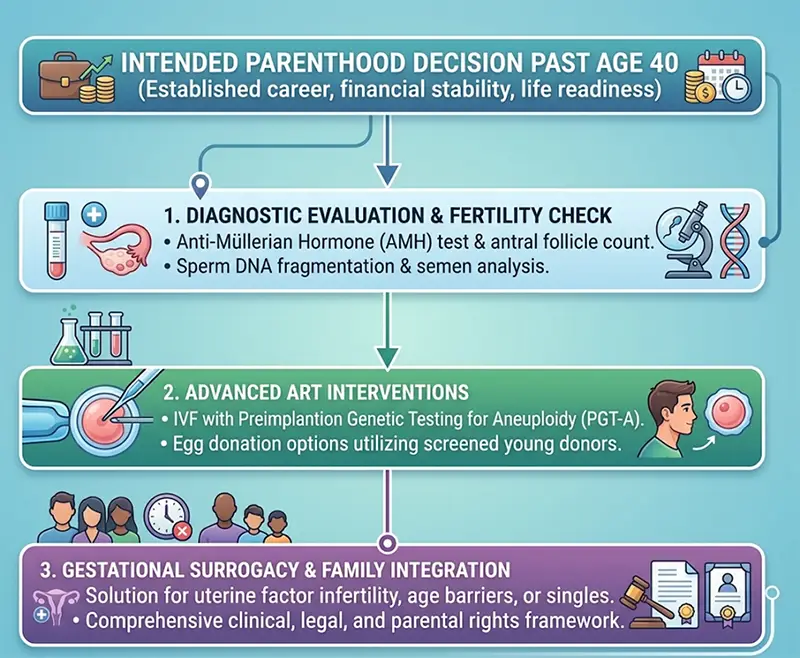
IVF with Preimplantation Genetic Testing (PGT-A)
In Vitro Fertilization (IVF) paired with PGT-A allows embryologists to screen blastocysts for chromosomal normalcy before uterine transfer. For individuals postponing pregnancy into their late thirties or early forties, identifying euploid embryos significantly reduces the risk of pregnancy loss and improves live birth rates per transfer.
Donor Gamete Options (Egg Donation)
When an intended mother’s ovarian reserve or egg quality no longer yields viable embryos, donor eggs from young, thoroughly screened donors provide exceptional success rates, bypassing age-related genetic factors completely.
Gestational Surrogacy
When uterine factors, medical contraindications, or structural barriers (such as single male parenthood) prevent traditional pregnancy, gestational surrogacy offers a medically proven, legally established solution.
For single American men who have focused on building financial stability and professional success before pursuing fatherhood independently, specialized programs such as surrogacy for single men provide complete clinical, legal, and operational guidance throughout every stage of the journey.
Establishing Family Protections and Legal Parentage
Embarking on a surrogacy or assisted reproductive journey in mature adulthood requires absolute legal clarity. Unlike traditional adoption, gestational surrogacy agreements establish clear parental rights prior to or immediately following birth through binding court orders or birth certificate designations, depending on the legal jurisdiction selected.
Navigating cross-border reproductive care allows intended parents to access high-quality medical standards, ethical surrogate compensation models, and transparent legal procedures. Selecting a reputable agency ensures that every clinical milestone, legal filing, and administrative detail is managed with care.
If you are evaluating options to start your family and want personalized guidance tailored to your timeline, we invite you to connect with our specialists via the Gestlife contact page, where our team will provide the information necessary to turn your family goals into a secure reality.
Financial Planning and Holistic Support Systems
Family building past age 40 requires transparent budgeting and coordinated support. Intended parents benefit from working with a multidisciplinary team that includes reproductive endocrinologists, reproductive attorneys, financial advisors, and mental health professionals.
By evaluating treatment costs, legal expenses, and agency coordination upfront, intended parents can proceed with confidence, knowing that their clinical care and legal parental rights are fully protected.
Sociological Perspectives on Delayed Parenting in Contemporary America
The shift toward delayed parenting is reshaping communities across the United States. According to demographic analyses conducted by the Pew Research Center, the median age of American mothers at first birth has increased from 21 in 1970 to nearly 27 today, with urban professional hubs recording median ages exceeding 30. For college-educated women and men, the likelihood of having a first child after age 35 has quadrupled over the past four decades.
This demographic restructuring has normalized mature parenting in school districts, workplace policies, and community organizations. Older parents often find supportive networks among peers who share similar life experiences, career milestones, and parenting philosophies.
Overcoming the Medical Stigma of “Advanced Age”
For decades, clinical terminology such as “advanced maternal age” or “geriatric pregnancy” created undue anxiety for expectant mothers over 35. Modern reproductive medicine is actively replacing outdated labels with supportive, evidence-based care models. Specialists recognize that while biological realities require careful diagnostic attention, healthy women in their late thirties and forties with proper prenatal care frequently experience excellent obstetric outcomes.
Furthermore, mature intended parents who spent years postponing family goals report feeling more emotionally grounded and less conflicted about stepping back from demanding work hours to focus on their children. Having achieved major career goals, they approach day-to-day parenting with deep presence and fulfillment.
Long-Term Cognitive and Emotional Development in Children of Mature Parents
Longitudinal studies tracking child development across diverse age cohorts reveal compelling insights regarding children raised by mature parents. Research published in developmental psychology journals indicates that children born to mothers and fathers over 35 often demonstrate advanced language skills, high academic performance, and strong emotional regulation.
Educational Resource Allocation
Mature parents typically possess established financial assets that allow for greater investment in educational resources, private tutoring, travel, and extracurricular activities. This socio-economic buffer provides children with enriched learning environments during critical developmental stages.
Harmonious Home Environments
Psychological maturity directly influences domestic dynamics. Mature parents are statistically less likely to report severe marital strain or parenting burnout, resulting in stable home environments that foster emotional security and self-confidence in growing children.
Conclusion: Embracing the Future of Family Building
Starting a family after 40 represents a deliberate, intentional choice that combines life wisdom with modern medical possibilities. Whether through advanced IVF, donor gametes, or international gestational surrogacy, intended parents today have access to safe, legally protected pathways that turn the dream of parenthood into a joyful reality.
Sources and Resources (Bibliography)
- PubMed / NCBI: Broekmans, F. J., et al. Female age-related fertility decline and reproductive outcomes in assisted reproduction. Clinical review indexed on pubmed.ncbi.nlm.nih.gov.
- American Society for Reproductive Medicine (ASRM): Age-related fertility decline: a committee opinion. Fertility and Sterility Journal. Available at: asrm.org
- Centers for Disease Control and Prevention (CDC): Assisted Reproductive Technology (ART) National Summary Report. Available at: cdc.gov
- National Center for Health Statistics (NCHS): S. Birth Rate Trends by Maternal Age. Available at: cdc.gov/nchs