Skip to content

The journey to parenthood through surrogacy is a remarkable path filled with anticipation, detailed planning, and profound love. For many intended mothers, the dream of motherhood isn’t just about welcoming a child into their home; it’s also about experiencing the physical closeness of breastfeeding. Through the science of induced lactation, this dream is entirely attainable.
Induced maternity lactation (lactancia por maternidad) allows women who have not carried a pregnancy to produce breast milk. This deeply educational and medical guide explores how intended mothers can prepare their bodies for breastfeeding, the emotional and health benefits, and how to navigate the lactation period (periodo de lactancia) and workplace accommodations.
Understanding induced lactation
Induced lactation is the process of stimulating breast milk production in a woman who has not recently been pregnant. It relies on mimicking the hormonal shifts that naturally occur during pregnancy and childbirth.
When a biological mother gives birth, the delivery of the placenta causes a rapid drop in progesterone and a surge in prolactin, signaling the body to produce milk. For an intended mother using a surrogate, this biological trigger is absent. Therefore, medical intervention and physical stimulation are required to trick the body into an artificial “pregnancy” and subsequent “birth.”
The Science behind the bond
Breastfeeding is widely recognized by leading health authorities, including the Centers for Disease Control and Prevention (CDC), for its extensive health benefits. Breast milk contains vital antibodies, enzymes, and white blood cells that protect the infant from infections.
Beyond nutrition, the skin-to-skin contact during feeding releases oxytocin—often called the “cuddle hormone”—in both mother and baby. This biochemical reaction reduces stress, lowers blood pressure, and builds a secure attachment, proving that the bond is formed by love and care, not just genetics or gestation.
Medical Protocols: The pathway to milk production
Inducing lactation requires time, commitment, and medical supervision, usually from a reproductive endocrinologist or an International Board Certified Lactation Consultant (IBCLC). The most widely recognized method is the Newman-Goldfarb protocol.
Phase 1: Hormonal preparation
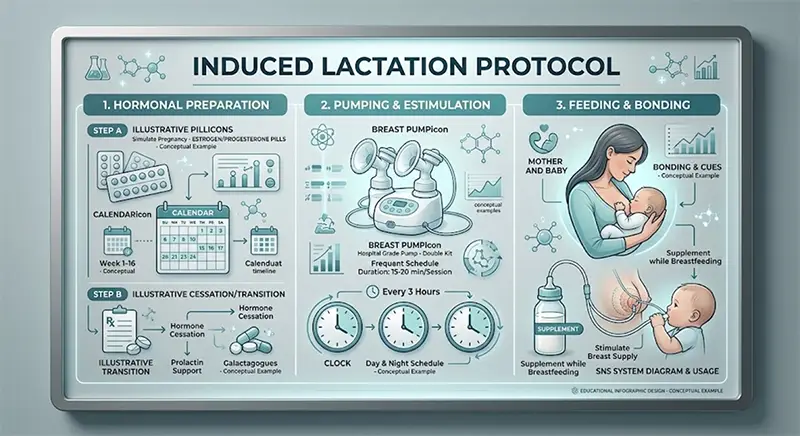
Ideally starting 3 to 6 months before the surrogate’s due date, the intended mother takes active birth control pills (combining estrogen and progesterone) continuously. This simulates the hormone levels of pregnancy, stimulating the development of milk ducts and glandular tissue. Simultaneously, a medication like domperidone (a galactagogue) is often prescribed to increase prolactin levels.
Phase 2: The “Mock birth”
About six weeks before the baby is expected, the birth control pills are stopped abruptly. This sudden drop in hormones mimics the delivery of the placenta, clearing the way for prolactin to initiate milk synthesis (lactogenesis).
Phase 3: Pumping and mechanical stimulation
Once the hormones are stopped, mechanical stimulation must begin immediately. The mother must use a hospital-grade double electric breast pump every 2 to 3 hours around the clock. This vigorous pumping schedule tells the brain that there is a “demand,” prompting it to supply milk.
Integrating lactation with the Surrogacy journey
Preparing for induced lactation requires meticulous synchronization with your surrogate’s timeline. As you prepare your body, it is essential to understand the broader context of the surrogacy process.
To fully grasp the timelines and legal frameworks involved, we recommend reading about what surrogacy is, the types, models, and key advantages. Furthermore, medical consultations, breast pumps, and medications add to your overall budget. Reviewing the surrogacy prices and programs can help you plan your finances effectively, ensuring a stress-free environment for your lactation period.
Workplace rights: Navigating lactation leave
A major concern for intended mothers is how to maintain their pumping schedule and care for their newborn while managing their careers. While the US does not have a federal “permiso de lactancia” (lactation leave) identical to European models, the landscape is improving.
The PUMP for Nursing Mothers Act
In the United States, recent legislation such as the PUMP Act requires employers to provide reasonable break time for an employee to express breast milk for their nursing child for one year after the child’s birth. Crucially, employers must provide a private space—other than a bathroom—that is shielded from view and free from intrusion.
- Advocating for your rights: Even as a mother by surrogacy, if you are actively lactating and feeding your child, you are entitled to these accommodations. It is vital to communicate with your HR department early to establish a plan for your lactation leave or pumping breaks.
- FMLA and Surrogacy: The Family and Medical Leave Act (FMLA) allows eligible employees to take up to 12 weeks of unpaid, job-protected leave to bond with a newborn, which applies to families formed via surrogacy just as it does to traditional births. Using this time effectively allows the mother to establish a solid feeding routine.
Setting realistic expectations
It is important to approach induced lactation with grace and realistic expectations. While some intended mothers produce a full milk supply, many produce a partial supply. This is completely normal and still a massive success.
Using a Supplemental Nursing System (SNS)
For mothers with a partial supply, a Supplemental Nursing System (SNS) is an incredible tool. It involves a container filled with supplemental milk (donor milk or formula) that the mother wears on a lanyard. Thin tubing runs from the container and is taped next to the nipple. As the baby latches and sucks, they draw in the supplement while simultaneously stimulating the mother’s breast to maintain or increase her natural milk production.
According to the American Academy of Pediatrics (AAP), any amount of breast milk provides distinct immunological and nutritional advantages. The ultimate goal of induced lactation isn’t just about the volume of milk produced; it’s about the profound, skin-to-skin bonding experience.
Conclusion
Embracing maternity lactation as an intended mother is a beautiful testament to dedication. By understanding the medical protocols, advocating for your lactation period rights at work, and utilizing the support systems provided by specialized agencies, you can create a nurturing and deeply connected start to your baby’s life.