Skip to content

Navigating an IVF journey requires immense emotional, physical, and financial investment. When a high-grade embryo transfer ends in a negative pregnancy test, it is disheartening. However, when multiple transfers fail consecutively, patients enter the challenging clinical category known as repeated implantation failure (RIF).
For American patients working through fertility clinics across the US and abroad, understanding why a genetically normal or top-grade embryo fails to attach to the uterine lining is crucial to pivoting your medical protocol and choosing the most effective route toward parenthood.
Defining Recurrent Implantation Failure in Modern Reproductive Medicine
The clinical definition of repeated implantation failure has advanced alongside embryological technology. In early IVF practice, RIF was diagnosed after three or four failed transfers of cleavage-stage embryos.
In contemporary American reproductive endocrinology, RIF is generally defined as the failure to achieve a clinical pregnancy after transferring at least two high-quality, morphologically sound blastocysts (Day 5 or 6), or specifically euploid blastocysts screened via Preimplantation Genetic Testing for Aneuploidies (PGT-A).
Successful implantation requires synchrony between the blastocyst and the receptive endometrium. When this cross-talk fails, physicians must investigate three core physiological domains.
The Three Core Pillars Behind Recurrent IVF Failure
When addressing repeated implantation failure, fertility specialists perform a systematic workup focused on the embryo, the uterine environment, and systemic maternal factors.
Embryonic Quality and Chromosomal Integrity
Even morphologically perfect embryos can harbor internal genetic defects. Chromosomal aneuploidy (extra or missing chromosomes) is the leading cause of early implantation failure and miscarriage. As maternal age rises, aneuploidy rates increase sharply—exceeding 60% in women over age 38.
Clinical research published by the American Society for Reproductive Medicine (ASRM) emphasizes that transferring genetically unverified embryos often leads to unexplained transfer failures. PGT-A testing allows embryologists to select euploid embryos, effectively ruling out embryonic aneuploidy as the primary cause of failure.
The Uterine Environment and Endometrial Receptivity
The endometrium is only receptive to embryo attachment during a brief period called the “window of implantation” (WOI). If a patient’s window is displaced (prereceptive or postreceptive), transferring an embryo during a standard timeline will result in failure.
Structural and inflammatory uterine pathologies also block implantation:
- Chronic Endometritis: A persistent, subclinical infection of the endometrial lining marked by CD138 plasma cells, which alters the local immune response.
- Uterine Structural Anomalies: Uterine septums, submucosal fibroids, endometrial polyps, or Asherman’s syndrome (intrauterine adhesions).
- Hydrosalpinx: Fluid-filled fallopian tubes that leak toxic fluid back into the uterine cavity, washing out embryos or preventing adhesion.
Immunological and Coagulation Factors
Implantation is an immunologically delicate event. The maternal immune system must recognize the embryo as “half-foreign” while actively tolerating its invasion into the uterine wall.
Autoimmune conditions, antiphospholipid syndrome (APS), or incompatibilities between maternal KIR uterine receptors and embryonic HLA-C markers can provoke localized immune rejection. Furthermore, inherited or acquired thrombophilias (such as Factor V Leiden) can lead to micro-thrombi at the implantation site, compromising early placental blood supply.
Advanced Diagnostic Testing Following Multiple Failed Transfers
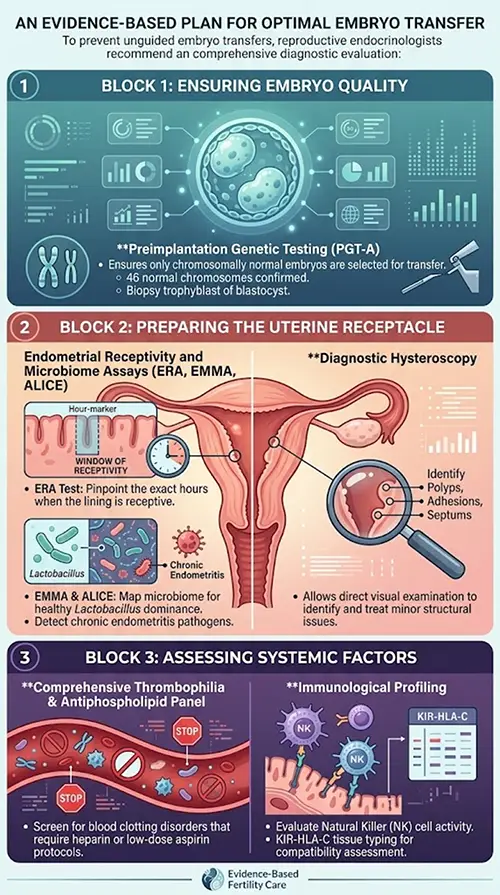
To prevent unguided embryo transfers, reproductive endocrinologists recommend an evidence-based diagnostic evaluation:
- Preimplantation Genetic Testing (PGT-A): Ensures only chromosomally normal embryos are selected for transfer.
- Endometrial Receptivity and Microbiome Assays (ERA, EMMA, ALICE):
- ERA Test: Evaluates gene expression to pinpoint the exact hours when the lining is receptive to embryo transfer.
- EMMA & ALICE: Map the uterine microbiome, ensuring healthy Lactobacillus dominance while detecting chronic endometritis pathogens.
- Diagnostic Hysteroscopy: Allows direct visual examination of the uterine cavity to identify and treat minor adhesions, polyps, or septums.
- Comprehensive Thrombophilia & Antiphospholipid Panel: Screens for blood clotting disorders that require heparin or low-dose aspirin protocols.
- Immunological Profiling: Evaluates Natural Killer (NK) cell activity and KIR-HLA-C tissue typing.
Exploring Alternative Medical Paths
When diagnostic testing identifies unresolvable egg quality or uterine barriers, couples and individuals must evaluate alternative treatment pathways.
Donor Eggs and Sperm
If egg quality is identified as the driving factor behind recurrent aneuploidy, transitioning to donor egg IVF raises live birth rates significantly per transfer, as donor eggs come from young, healthy donors.
Comprehensive Strategy for Heterosexual Couples
Recurrent repeated implantation failure is not solely a female-factor issue. High sperm DNA fragmentation and severe male factor infertility can severely impair blastocyst development and post-implantation viability. For couples evaluating male factor contributions and full-service IVF protocols, reviewing structured options for heterosexual couples navigating fertility treatments provides essential guidance.
Gestational Surrogacy for Irreversible Uterine Factors
When uterine damage is permanent—such as severe Asherman’s syndrome, uterine hypoplasia, extensive adenomyosis, or recurrent immune rejection—the uterine environment cannot safely sustain a pregnancy despite the availability of healthy embryos.
In these circumstances, gestational surrogacy provides a proven medical and legal pathway to biological parenthood. A gestational carrier carries the pregnancy using embryos created via the intended parents’ gametes or donor eggs/sperm.
Navigating gestational surrogacy requires strict legal frameworks to protect parental rights. Intended parents must understand international legal landscapes and identify countries where regulated gestational surrogacy laws exist to ensure a smooth, ethically sound process.
Strategic Action Plan for Patients
Facing recurrent transfer failure demands a methodical, research-backed strategy:
- Pause unguided transfers: Investigate root causes before using remaining embryos.
- Optimize the uterine lining: Treat chronic endometritis with targeted antibiotics and perform hysteroscopic corrections.
- Test embryo genetics: Utilize PGT-A to confirm chromosomal normalcy.
- Consider gestational surrogacy early: If uterine factors are non-remediable, surrogacy provides the highest probability of bringing home a healthy baby.
With clinical precision and tailored protocols, intended parents can navigate past implantation barriers and achieve their dream of building a family.