

If you are an American couple or an individual weighing fertility options abroad, you have probably noticed one thing: Spain comes up again and again. The country is a European hub for IVF and egg donation, yet it is also one of the places where surrogacy contracts are void. Both facts come from the same statute, Law 14/2006 of May 26 on assisted human reproduction techniques. This guide breaks it down in plain English, flags where it differs from the rules most Americans are used to, and explains what it means for families who explore surrogacy elsewhere.
The big picture in five lines
Before going deeper, here is the short version. Spain allows IVF, artificial insemination and gamete donation under strict medical and legal oversight. Access is open to adult women regardless of marital status or sexual orientation. Donations are voluntary, unpaid and confidential. Legal motherhood is determined by childbirth. In addition, any agreement for a woman to carry a pregnancy and hand over the baby is null and void, paid or not.
Why the United States works so differently
The United States has no single federal law governing assisted reproduction. Clinics follow professional guidelines from bodies such as the American Society for Reproductive Medicine, report outcomes to the CDC’s ART surveillance program, and operate under a patchwork of state laws. Surrogacy, for example, is clearly regulated in some states and restricted in others. Spain, in contrast, centralizes the rules in one national statute, backed by the Ministry of Health and a national commission on assisted reproduction.
That contrast is useful context. When you read Spanish rules about donor anonymity or surrogacy, remember you are looking at a civil-law system built around a single code, not a case-by-case approach as in many U.S. courts.
What the law covers
Law 14/2006 replaced Spain’s first assisted reproduction statute from 1988. It was published in the official gazette (BOE) on May 27, 2006, and it has been amended in specific points since. You can read the consolidated text on the BOE website, though it is in Spanish. In practice, the law covers:
- Artificial insemination and in vitro fertilization with embryo transfer.
- Use of donated eggs, sperm and embryos.
- Preimplantation genetic testing under defined conditions.
- Cryopreservation of gametes and early embryos.
- Licensing and oversight of clinics and tissue banks.
The World Health Organization notes that infertility affects roughly one in six people worldwide, according to its infertility fact sheet, which is why many countries have built regulatory frameworks like Spain’s.
Who can use assisted reproduction in Spain
Spanish law is notably inclusive. Article 6 allows any woman over 18 with full legal capacity to access treatment, as long as she gives written, informed consent. Marital status and sexual orientation are irrelevant. That means single women, same-sex female couples and heterosexual couples can all qualify. Treatment must also have a reasonable chance of success and must not involve a serious health risk for the woman or the future child.
Public hospitals often layer on their own criteria, such as age caps, but private clinics follow medical judgment and the law. International patients are welcome, though they must comply with the same consent and documentation requirements as residents.
Donor rules: unpaid, anonymous and capped
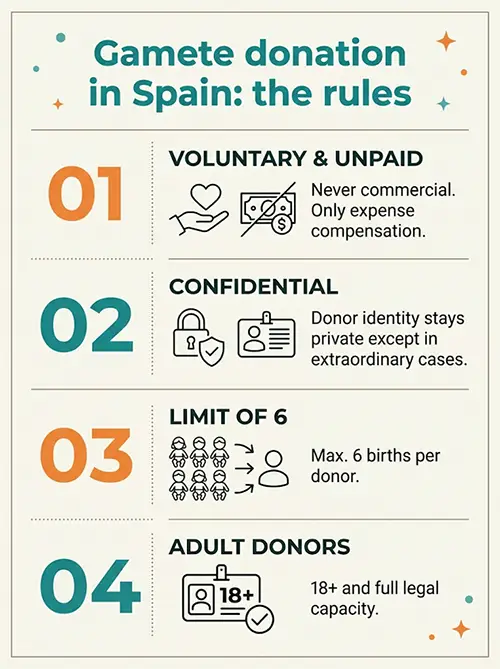
Under Spanish law, donating eggs, sperm or embryos is a free, formal and confidential agreement with an authorized center. It cannot be commercial. Donors may receive compensation for physical inconvenience, travel and lost work time, but not a financial incentive. This differs sharply from the U.S., where egg donors are commonly paid several thousand dollars.
Donor identity is kept confidential. Children conceived through donation can request general information about the donor, but not their identity, except in extraordinary situations such as a real threat to the child’s life or health. The law also caps births at six per donor. Several European countries, including the United Kingdom, regulate donor anonymity and limits differently; the HFEA is a good reference for the British model.
Parentage: who is the legal parent?
Parentage in Spain follows civil code rules, with specific provisions for assisted reproduction. If a couple consents beforehand, parentage follows that consent. A female spouse can declare consent so she is recognized as the second mother. The donor never acquires legal parentage.
The key principle for surrogacy is that the birth mother is the legal mother. That sets Spain apart from some U.S. states, where pre-birth orders can establish parentage for intended parents before the baby is born.
What Article 10 says about surrogacy
Article 10 declares null and void any contract under which a woman agrees to gestate a child, with or without payment, and gives up maternal parentage in favor of the contracting party or a third person. Parentage of a child born in this way is determined by childbirth. The only exception is that biological fathers can still bring a paternity claim under general rules.
In short, surrogacy is not allowed in Spain, whether commercial or altruistic. The wording makes no distinction between the two, which is why debates about altruistic surrogacy in Spain remain theoretical, a matter for future legislation rather than current law.
Surrogacy terminology: what does “womb for rent” mean?
You will find different expressions for the same practice. Spanish law says «gestación por sustitución» (gestation by substitution). Critics prefer the phrase «vientre de alquiler» (womb for rent) because it emphasizes commercialization. Supporters use «surrogacy» or «gestational surrogacy», which focus on the surrogate’s autonomy and informed consent. As a family-building company, we use neutral and precise language, because the words you choose shape the way the topic is discussed.
Another useful distinction is between altruistic surrogacy, where the surrogate only receives reimbursement for expenses, and compensated surrogacy, where she also receives agreed compensation. Each country that regulates surrogacy picks its own model.
What happens when children are born abroad
Spanish citizens have turned to other countries, including the U.S., for surrogacy. Registering those children in Spain has been legally complex. A 2010 administrative instruction allowed registration with a foreign court decision; the Supreme Court addressed the issue in 2022; and in 2025 Spain’s registry authority issued a new instruction changing the criteria. Because rules change, intended parents with Spanish ties should always consult a lawyer specialized in international family law.
At the international level, the European Court of Human Rights has held that a child’s best interests require some way to recognize the bond with the intended parent. The Hague Conference on Private International Law is also studying a global framework on parentage and international surrogacy.
Myths vs. facts
- Myth: Spain allows altruistic surrogacy.
Fact: Article 10 voids all surrogacy agreements, paid or unpaid. - Myth: Only married heterosexual couples can use IVF in Spain.
Fact: Adult women can access treatment regardless of marital status or sexual orientation. - Myth: Egg donors in Spain are paid like in the U.S.
Fact: Donation is legally non-commercial; only compensation for inconvenience and expenses is allowed. - Myth: A foreign surrogacy contract is automatically valid in Spain.
Fact: Recognition depends on court and registry decisions, not on the foreign contract alone.
What this means for heterosexual couples and budgets
For many heterosexual couples, IVF in Spain, with or without donor gametes, is a straightforward path. Others face medical situations where carrying a pregnancy is not possible, and they investigate surrogacy in countries where it is regulated. If that is your case, take a look at how our surrogacy programs for heterosexual couples work, and then compare the cost of surrogacy so you can plan realistically.
Key takeaways
Spain’s Law 14/2006 is a modern framework for fertility treatment and a firm barrier to surrogacy contracts. Understanding both sides helps you avoid misinformation, compare legal systems and decide with confidence. Check official sources, speak with qualified legal and medical professionals, and give yourself time to evaluate every option before committing.